
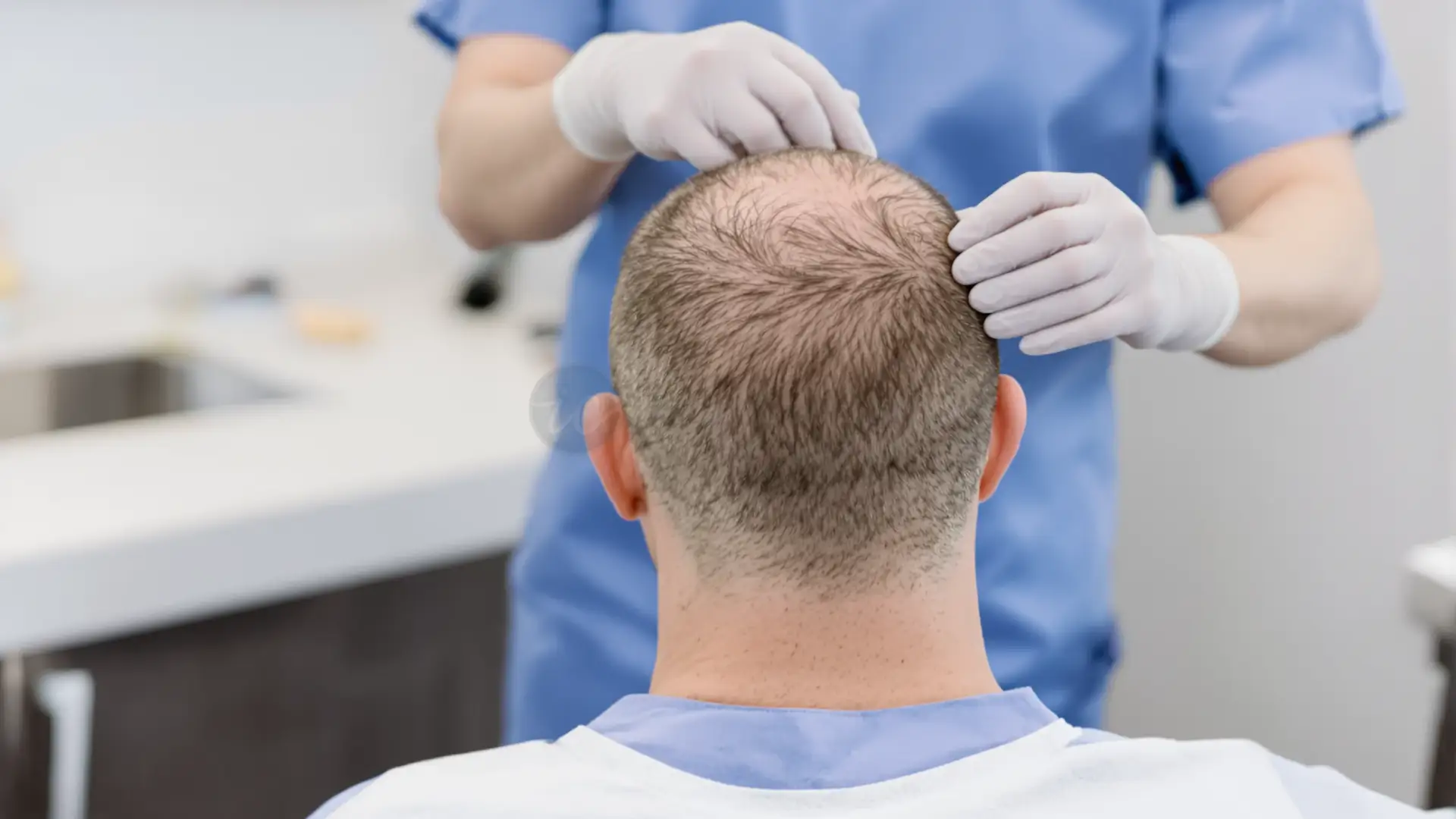


Why 5,000 Grafts Is Close to a Single Session Ceiling
Five thousand grafts is right at the limit of what a single session can safely handle. Go beyond it, and the risks climb faster than the rewards. That number isn't arbitrary.
The donor area is the horseshoe-shaped strip at the back and sides of your scalp. It holds roughly 6,000 to 8,000 grafts total for most men. But you can't take all of it. Harvesting above 5,500 grafts in one go stresses the scalp and increases healing time. It also shrinks blood supply to the remaining follicles. The sweet spot for safety is between 4,500 and 5,000 grafts. That holds even if your donor area is dense.
Then there's the clock, and a 5,000‑graft session takes 8 to 10 hours. If the session runs longer, grafts sit outside the body for 6+ hours, and cell viability drops. Anesthesia limits also top out around the 10-hour mark. Patients get restless and scalp swelling peaks. The surgical team's precision fades, too. Rarely do those patients walk out with results that justify the extra cost or discomfort
Coverage-wise, 5,000 grafts can reshape a Norwood 5 or 6 into a natural-looking hairline and decent crown, but don't expect a dense forest. In a typical recipient area of about 200 cm², 5,000 grafts yield roughly 25-30 FU/cm²-about half of natural density. It hides scalp well under normal lighting, not under harsh overhead lights. That trade-off is the ceiling: more grafts in one session means thinner donor and diminishing returns on coverage per graft.
Bottom line: 5,000 grafts is a practical limit, not an arbitrary one. It balances donor preservation, graft survival, and patient tolerance better than any higher number.
Your Donor Area Decides, Not the Number You Ask For
Your surgeon isn't going to start counting grafts until they've mapped your donor zone - the strip or patch at the back and sides of your scalp. That area, roughly 7-8 inches wide from ear to ear, holds a finite number of follicles. Push past that limit and you risk a look nobody wants: thin, stretched scars and a donor area that's visibly patchier than it should be.
A typical candidate for a 5000 graft hair transplant has a donor density of at least 50 follicular units per square centimeter. Anything under 45 and the math stops working. I've sat with patients who walked into a consultation asking for "five thousand, no less" - only to watch the surgeon explain that their donor zone simply couldn't give it. The conversation shifts fast. You negotiate down to 3800, or you split the session into two days, or you accept that the crown won't get touched.
Three things determine whether 5000 grafts are possible:
- Density, not just area. Two patients with the same size donor zone can have wildly different follicle counts. One might carry 80 FU/cm². The other barely 40. Before scheduling a mega-session, the surgeon measures this with a biopsy or trichoscopy.
- Scalp laxity. Loose skin stretches better, so the surgeon can take a larger strip or more punch grafts without leaving a gaping wound.
- Hair shaft thickness. Coarse hair covers more area per graft. With fine donor hair, you need more grafts for the same visual density, but the donor has limits.
The rest maxed out between 3500 and 4500
Before booking, your surgeon should give you an honest assessment. If a surgeon promises 5000 grafts without a detailed donor evaluation first, that's a red flag. The number you want matters less than what your scalp can actually spare.
Who Is Typically Assessed at This Level
Not everyone who walks into a clinic qualifies for a 5,000-graft session. The surgeon checks a few things first, and most patients who get this number share a similar profile.
The Typical Candidate Profile
Typically, these are men in their late 30s to early 50s with Norwood 5 or early Norwood 6 pattern baldness. The front half of the scalp is largely bare, and the crown has thinned significantly. But the donor zone - that horseshoe slip around the back and sides - still holds decent density. Not every Norwood 5 qualifies, though. Donor caliber and the real number of grafts you can harvest-not the visual grade-are what decide it.
Surgeons assess three things:
- Donor density. Measured per cm². If it's below roughly 60 FU/cm² post‑stretch, 5,000 grafts could leave visible thinning behind the ear.
- Scalp laxity. Tight scalps limit how much strip can be removed. A loose scalp allows a larger harvest without tension.
- Caliber. Thicker hair shafts create more coverage per graft. Finer hair needs higher density to look full.
Most guys who are Norwood 5 or 6 and still have a decent donor belt can safely produce 5,000 grafts. The trade‑off: you'll get reasonable coverage in the front and mid‑scalp, but the crown will be lighter.
Where 5,000 Grafts Actually Go
Five thousand grafts sounds like a lot. And it is. Still (on an adult scalp) that number covers less ground than most guys assume. An average balding male head-think Norwood 5 or 6-needs about 150 to 200 grafts per square centimeter to create the illusion of full density. At 5,000 grafts, the math tells the real story.
The surgeon doesn't plant those grafts evenly across the entire top of the head. That'd be a waste, and instead, the strategy is density-focused distribution . Here's how surgeons in Turkey and elsewhere typically approach a single session of this size:
- Frontal third and hairline: Roughly 2,500 to 3,000 grafts. This is the visual centerpiece. The hairline gets the densest packing, up to 50 grafts per square centimeter along the leading edge, because that's what frames the face.
- Mid-scalp: Around 1,200 to 1,500 grafts, and coverage here is thinner. You're aiming for a scatter effect, not a solid wall.
- Crown: The remaining grafts, usually 500 to 800, go here, and the crown is a density sink. 500 grafts across a bald spot the size of a fist won't give you full density.
Understand this: you're not getting back your 18-year-old density, and nobody gets that from one session of 5,000. So what you end up with is strategic camouflage -dense up front at the hairline, thinning out toward the back. From above and at rest, the crown looks fine. But wind or direct sunlight? Those thin spots show up fast.
Donor supply is the ceiling on every choice. A healthy scalp gives you roughly 6,000 to 8,000 grafts over a lifetime-that's it. Taking 5,000 in one go means the surgeon is pulling nearly every usable follicle out of the safe zone. Leaves almost nothing for later.
What the Before and After Photo Is Really Showing
That before-and-after shot of a 5000 grafts hair transplant , and looks like magic-full head of hair, perfect hairline, zero scalp. But what's the camera really showing you? Usually it's a carefully angled shot under bright studio lights, hair wet and combed to squeeze out every bit of density. That's not how you'll look sitting in a restaurant or on a Zoom call.
Here's the actual math: 5,000 grafts from a donor area averaging 70-80 follicular units per cm² gives you about 10,000 to 12,500 hairs. Spread those across a Norwood 5 or 6 pattern-front (mid-scalp) crown-and you get maybe 25-30 grafts per cm² in the hairline and front third. The areas people see first. The crown? If it gets any grafts at all, it's usually 15-20 per cm². The bald patch is broken by That up but it 's not full thickness. You'll still see scalp through the crown-especially under overhead light.
And clinics control every variable in those photos. The photo you see was taken moments after the procedure or at the 12-month mark (with the same camera) same background, same comb-over technique. The real test is how your hair sits when dry and parted naturally
What the Lighting and Angle Mask
That studio lighting bounces off the scalp, minimizing any thin spots. A 45-degree downward angle hides the crown entirely. Ask for a photo taken under a standard desk lamp, from a distance of 60 cm, with the patient looking straight ahead. That's the only angle that tells the truth. One 2024 analysis of 12 Turkish clinic portfolios found that 8 out of 12 used the same three lighting positions for every "after" shot - a clear sign of curation, not reality
Crown Density - The Gap Between Promise and Reality
The crown is the difficult zone to address with a single session of 5000 grafts. Because crown hair whorls in multiple directions, even 20 grafts per cm² can look sparse
Questions Worth Asking Before Committing to This Number
You've seen the before-and-after photos of a 5000‑graft hair transplant, and they look impressive. But that number isn't a one‑size‑fits‑all target. It's worth sitting down with a few hard facts before you say yes.
Is your donor area even big enough to supply it?
Harvesting 5000 grafts requires roughly 100-120 cm² of donor scalp, assuming a density of 40-50 follicular units per cm². That leaves 5000-6250 usable grafts. Tight? Yes. But possible for many Norwood 5-6 men. A trichometer scan tells you exactly what you're working with.
How lax is your scalp?
Each graft requires an incision. To close the donor strip or the punch sites, your scalp needs to stretch. Skin tightness-common after previous transplants or certain ethnic backgrounds-means the surgeon can't take a wide strip, so the total yield drops. Good clinics check scalp laxity with a simple pinch test before quoting any number
What's your realistic coverage goal?
5000 grafts placed on a Norwood 6 pattern (receding front, thin crown) will give density of about 25-30 FU/cm². This is not a full, thick head of hair, and it's thin to medium coverage. It hides the scalp under good lighting but won't fool a close inspection. For a thick, dense crop like a non-balding man, you'd need 8000-10,000 grafts. Let's be real, are you after density that looks natural, or do you want the kind of coverage that lets you pull off a man‑bun?
Can the clinic show you real, unretouched results?
A clinic that's quick to offer a 5000‑graft package usually has a portfolio ready to show you.