:no_upscale()/media/ahc/images/2026/02/26f8b237813749afb443e051b9cbe47b.webp)
:no_upscale()/media/ahc/images/2026/08/antonio-conte-trapianto-capelli-copertina-albania-hair-clinic.webp)
Antonio Conte and the Hair Transplant: What Public Photos Show
Antonio Conte and His Hair Transplant: What Public Photos Show
Antonio Conte has spoken about his hair only once, on television, and those words are the only verifiable thing on this page. Elsewhere on the internet, his name appears in dozens of articles estimating grafts, techniques, locations, and figures: none of those details trace back to a statement by the coach. Here we report what he said, with the source; what is and is not visible in the two licensed photographs published on this page; and what a national health service publishes about the procedure and its timelines.
Editor's note. Albania Hair Clinic has neither visited nor treated Antonio Conte and has no access to any medical records. Nothing on this page states or implies that Antonio Conte has undergone a hair transplant or any other treatment, at this clinic or elsewhere. The photographs here are licensed images that identify only the person: they are not before-and-after documentation, and the photographers do not endorse this page.
What Antonio Conte said, in his own words
The Corriere della Sera, in a feature dedicated to curiosities about the coach, reports a statement he made on «Le Iene»:
«Look, especially for a footballer, is important. Today we live in a society of image, and not taking it into account is a serious mistake, in my opinion. You see, I was half bald, completely bald, and now I have my new hair, which I get along with well, indeed very well».
Those are his words, and they are all that exists. The same article adds a clarification that is worth more than any third-party reconstruction: Conte «has never made official statements about the details». He has not indicated a technique, a date, a place, or a number.
This page stops exactly here, because beyond this point there is no verifiable source. «New hair» is the phrase the person in question chose: replacing it with a clinical term he did not use would mean attributing to him a procedure he never described. The figures circulating associated with his name — number of grafts, cost, name of a facility — cannot be traced to anything he or a verifiable source has published, and for this reason they are not repeated here.
The two photographs on this page: date, place, and context
The cover photograph was taken on the evening of June 16, 2015 in Geneva, on the sidelines of Portugal-Italy; the file's metadata on Wikimedia Commons records 9:47 PM. It is a close-up frontal portrait at a press conference: microphone in the foreground, sponsor logos on the backdrop out of focus, jacket and tie, direct light on the face. The hairline is readable, and the hair is combed back and up.
The second image, below, is dated January 4, 2012, during a Juventus tour in Dubai: a nighttime outdoor shot with close-up flash and a completely black background, wearing the team tracksuit. The framing is slightly from below, so the crown of the head remains out of view.
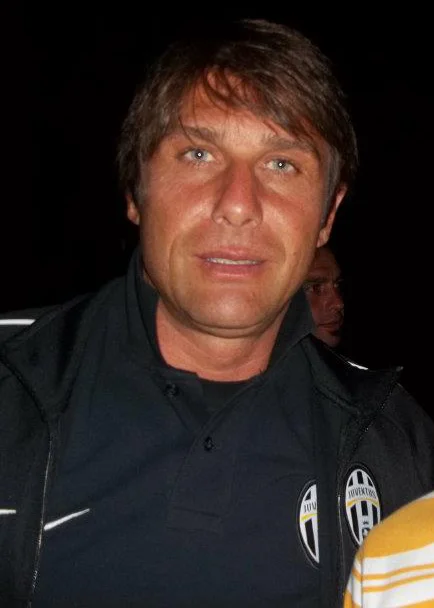
There is also a technical difference worth putting in writing, because almost no one considers it. The original of the cover measures 2223 by 2902 pixels; the Dubai one 434 by 608. The second image has a pixel area over twenty times smaller than the first: it is not comparable material, and it does not become so by enlarging it, because enlargement does not add information that was not recorded.
The two images are about three and a half years apart, and both are subsequent to the period to which the phrase «I was half bald, completely bald» refers. In other words: they do not document a before and an after. They document two moments of the same «after», with different lighting, lenses, distances, resolutions, and hairstyles. It is a distinction that almost no page on this topic bothers to make, and it completely changes what it is legitimate to infer.
Why two photographs cannot answer the question
A direct flash flattens shadows and fills the gaps between hairs: the same head, shot with raking side light, appears more thinned out. A shorter lens brought close to the face widens the forehead; a longer one compresses it. A slightly high-angle shot reveals the crown, a slightly low-angle one hides it completely. Wet hair separates and reveals the scalp; the same hair, dry and combed forward, covers it.
For this reason, you will not find a before/after comparison here, an estimate of grafts, or a technique attributed to a person who has not mentioned it.
«New hair» is not the name of a procedure
The formula chosen by the coach is not a clinical term, and the NHS page on hair loss helps to understand how many different things it could describe. In its list of treatments, the British health service keeps separate, as distinct items: steroid injections, steroid creams, local immunotherapy and tablet immunotherapy, phototherapy, permanent makeup or micropigmentation — described as a tattoo made to resemble short hair —, hair transplant, scalp reduction surgery, and artificial hair implantation.
Before that list, the same page dedicates a chapter to wigs, and distinguishes them precisely: synthetic ones last from six to nine months and are simpler to maintain, those made of real hair last from three to four years, appear more natural and cost more.
None of these items is suggested here to anyone, and none is attributed to Antonio Conte. The point is another: in current Italian, the expression «new hair» fits several of those items, and the person who said it has not chosen among them. The pages that translate that phrase into a technique with a number of grafts are not reporting: they are filling a void. Those who instead want to understand how to arrive at an informed choice find the path described in our patient guide.
What a hair transplant is, according to the British health service
For the general part, this page relies on the page of the British National Health Service, which is public and non-commercial. The NHS defines the procedure as moving hair to a thinning or bald area and specifies that it is not provided by the public service, because it falls under cosmetic surgery. It indicates it as suitable for permanent baldness, the one that runs in families, and normally not suitable for other forms of hair loss, such as the one that produces patches (alopecia areata).
The techniques described are two. In follicular unit transplantation, the so-called strip method, a thin strip of skin with hair is taken from the back of the head, divided into grafts of one to four hairs that are placed in small incisions in the scalp; the donor area is closed with stitches and leaves a scar that, the NHS writes, should not be visible unless wearing hair very short, and the head does not need to be shaved because only the area of the extraction is shortened. In follicular unit extraction, the back of the head is shaved and the hairs are taken one at a time: many tiny scars remain, which the NHS describes as not very evident.
On the day of the procedure, the page writes that it is usually performed under local anesthesia with sedation, so the person is awake but should not feel pain; that it normally takes a day, without overnight stay; and that a large area may require two or more sessions on different days.
The times the NHS indicates after the procedure
This is the part that almost no page about a famous person reports, and it is the one that makes any reading of a single photograph useless. The NHS indicates that one or two weeks off work may be needed; that in the first two weeks the grafts are not stable and must be treated with great caution; and that in the first month it is advisable to reduce physical activity to limit scarring.
Then it lists a schedule. After two to five days, any dressings can usually be removed, without touching the grafts. On the sixth day, the hair can generally be washed gently by hand. After ten to fourteen days, any non-absorbable stitches are removed. After a few weeks, the transplanted hair often falls out, then starts to grow again. After about four months, new hair usually appears. The complete result, the NHS writes, is seen between ten and eighteen months. The practical instructions we give to our patients follow the same logic and are collected in the instructions for hair transplant.
Between the Dubai photograph and the Geneva one, three and a half years pass. A schedule like the one described above says that the visible appearance of a head can change substantially within just one of those years, for reasons that have nothing to do with the moment the shutter opened. Two isolated shots in such an interval are not a series: they are two points chosen at random.
On expected effects, the NHS lists a tight, sore, and swollen scalp for a few days, temporary scabs in the transplanted area, and a single scar or numerous very small scars. On risks, it is equally dry: the procedure is defined as generally safe, but with a small risk of bleeding, infection, or allergic reaction to the anesthetic, and with a further small risk that the transplant does not take and the hair falls out, or that an evident scar forms. Finally, it adds a point that weighs heavily over time: the hair can continue to thin around the transplanted area, and the surgeon should plan the procedure taking this into account.
Why one coach's case doesn't anticipate yours
Conte talked about his look and nothing more specific. But even a complete and documented account of another person's operation would say nothing about yours: the NHS links the outcome to the individual pattern of hair loss, the available donor area, and the design of the procedure. A television quote and two photographs contain none of those three pieces of information. Only an individual assessment does.
Frequently asked questions
Did Antonio Conte have a hair transplant?
He never stated so. On «Le Iene» he said he was «half bald, completely bald» and that he now has his «new hair», but Corriere della Sera specifies that he has never made official statements about the details. No technique, date, or facility has been confirmed by him.
How many grafts would he have received?
No figure is verifiable. The numbers circulating on commercial pages cannot be traced to any statement by the person concerned and are not repeated on this page.
Where would he have had the procedure?
He has not indicated any place or facility. Albania Hair Clinic does not claim any connection with Antonio Conte.
Are the two photos on this page meant as a comparison?
No. They are from January 4, 2012, and June 16, 2015, so both are later than the quoted statement, and they are technically incomparable: 434 by 608 pixels for the first, 2223 by 2902 for the second, with different lighting, distance, and framing.
How long does the NHS indicate before seeing a result?
It writes that after a few weeks the transplanted hair often falls out and then grows back, that new hair usually appears after about four months, and that the full result is seen between ten and eighteen months.
Albania Hair Clinic has no professional relationship with Antonio Conte and makes no claim about his medical history beyond the public statements cited and linked on this page. The general information is taken from the NHS's public documentation and does not constitute personal medical advice.
Cover photo of Antonio Conte: Clément Bucco-Lechat — Wikimedia Commons, CC BY-SA 3.0. Used under license; the photographer does not endorse this page and the image is not proof of any procedure.
Photo in the article of Antonio Conte: F1fans — Wikimedia Commons, CC BY-SA 3.0. Used under license; the photographer does not endorse this page and the image is not proof of any procedure.
Back to the index of famous people · What a hair transplant involves
Reach Us Now
Speak with our expert DHI Hair Transplant specialist We're ready to answer your questions
:no_upscale()/media/ahc/images/2026/04/contact-doctors.webp)