:no_upscale()/media/ahc/images/2026/02/26f8b237813749afb443e051b9cbe47b.webp)
:no_upscale()/media/ahc/images/2026/08/federico-gatti-trapianto-capelli-copertina-albania-hair-clinic.webp)
Federico Gatti and Hair Transplant: What Public Photos Show
Federico Gatti and Hair Transplant: What Public Photos Show
Federico Gatti has never said anything publicly about his hair, and this page does not fill that void with speculation. It is an uncomfortable choice, because the pages that rank for this search are almost all from clinics that indicate techniques, graft counts, and dates as if they were documented. They are not. What follows is the list of what is verifiable, what is not, and what a national health service publishes about hair loss in general.
Editorial note. Albania Hair Clinic has neither visited nor treated Federico Gatti and has no access to any medical records. Nothing on this page states or implies that Federico Gatti has undergone a hair transplant or any other treatment, at this clinic or elsewhere. The photographs shown here are licensed images that only identify the person: they are not before-and-after documentation, and the photographers do not endorse this page.
What Federico Gatti has stated: nothing
As of the review date of this page, there is no public statement by the defender regarding a hair treatment: no post, no interview, no press conference. Therefore, the most solid category of source — the words of the person concerned — does not exist, and this page says so openly instead of sidestepping the issue.
What is found online belongs to three categories, all weak. There are clinic pages that reconstruct a complete clinical pathway, including technique and graft count, without indicating where the information comes from. There are forum discussions and social media comments where fans observe match frames. And there are videos by content creators who analyze images and propose a conclusion. None of these three things is a source: the first has a direct commercial interest, the second and third are personal observations on photographic material that, as seen below, does not allow that kind of reading.
The biographical and sporting data, those yes, are verifiable: according to Italian Wikipedia, Federico Gatti was born in Rivoli on June 24, 1998, and is a defender for Juventus and the Italian national team, having reached professional football after a path starting from the lower leagues. On everything else, the honest answer is that it is not known.
The two licensed photographs are twenty-one days apart: October 2 and 23, 2021
This is the most important limitation to state, and it is also the reason why this page does not attempt comparisons. The Wikimedia Commons file dates the cover photograph to October 2, 2021, during a home match of Frosinone against Cittadella at the Benito Stirpe stadium; the second image is dated October 23, 2021, at home against Ascoli. Twenty-one days, same Serie B season, same photographer.
The cover is a close-up portrait on the field, in daylight, with the stands out of focus in the background: Frosinone's yellow jersey with the Banca Popolare Frusinate sponsor, damp hair combed back, very short sides. The second is a full-length shot during a celebration with an arm raised, with the number 6 on the shorts and, on the jersey, a second sponsor that does not appear in the cover: a detail confirming that they are two different matches. The head occupies a tiny portion of the frame and the hairline is practically illegible.
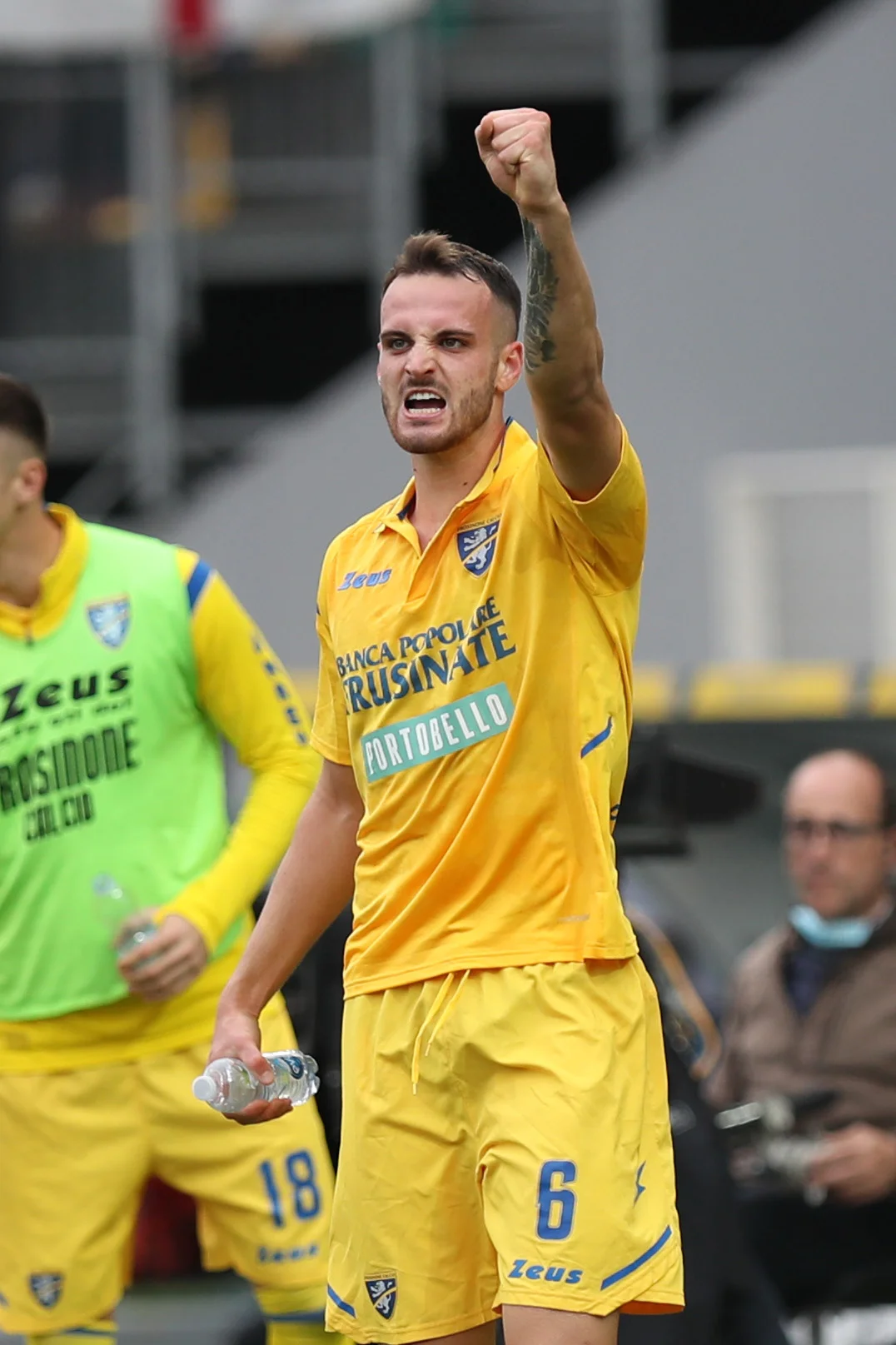
Twenty-one days cannot show a change over time. It is an arithmetic triviality, but it is exactly what is missing from the pages that place a recent image next to an old one and call that montage a «before and after». For that kind of reading, licensed images from distant periods, taken under comparable conditions, would be needed, and for this person we do not have them. The only before-and-after sequences we publish are those of our patients, collected with their consent and under known conditions. We prefer to say that rather than simulate it.
Why a photograph says much less than it seems
Even with images from distant periods, the margin of error would remain high. Sweat-dampened hair separates and reveals the scalp: the same dry head appears fuller. The full light of a stadium afternoon carves shadows that diffused light erases. A long lens compresses planes and reduces the forehead; a short one widens it. A very shaved cut on the sides increases the contrast with the top and makes the hairline read differently with the same amount of hair.
It should also be noted that in the NHS page on hair loss, permanent makeup, or micropigmentation, is listed as a distinct item from transplantation and is described as a tattoo designed to resemble short hair. In a photograph, the two outcomes can look very similar. Calling what is seen in a still image a «transplant» means choosing one word among several possible ones, not recording a fact.
What the NHS indicates as a cause of hair loss
The same public page from the British health service starts from a fact that puts many discussions into perspective: losing between 50 and 100 hairs a day is normal and often goes unnoticed. Some forms of hair loss are permanent — male and female pattern baldness, which usually runs in families. Others are temporary, and the NHS lists their causes: illness, stress, cancer treatment, weight loss, iron deficiency. When hair loss is due to a medical condition, it writes, it usually stops or the hair grows back once the condition is resolved.
This point matters a lot on a page like this. A photograph shows a state, not a cause: two heads that look identical in a frame can have different origins and different prospects. The NHS adds that most hair loss does not require any treatment, because it is temporary and resolves on its own or is part of normal aging.
On the order of steps, the page is explicit: it invites you to see your doctor to understand what is causing the hair loss before thinking about a commercial clinic. On medications, it lists finasteride and minoxidil as the main treatments for male pattern baldness, specifies that minoxidil is also used for female pattern baldness while women should not take finasteride, and reminds that these treatments do not work for everyone and only work as long as they are used. Then it makes a statement that leaves no room for doubt: no treatment is one hundred percent effective.
The checks the NHS lists before choosing a clinic
On the surgical side, the NHS publishes a dedicated page, non-commercial, which is unusually direct on how to approach the decision. For those considering the procedure in England, it asks to verify that the hospital or clinic is registered with the Care Quality Commission: this is a requirement for all private cosmetic surgery providers in the country. It reminds that every doctor must be registered with the General Medical Council with a license to practice, and refers to the British Association of Hair Restoration Surgery to check a surgeon's affiliation.
It then lists, one by one, the questions to ask the surgeon: qualifications and experience; how many procedures of this type they have performed; how many involved complications; which technique they would recommend and why; what follow-up to expect if something goes wrong; what their patient satisfaction rates are. These are questions that apply to any clinic, including this one: the profiles and credentials of our surgeons are public precisely because those questions make sense.
And there is a warning that falls exactly on the point from which this page started: «Be careful when searching online for clinics that perform hair transplants. Some pay to advertise their services in search engine listings». This is the environment in which the phrase «Federico Gatti had a hair transplant» was born: not from a statement, but from pages competing for a search.
Why an answer about someone else is not an answer about you
None of the above describes anyone's individual case. The pattern in which hair thins, the density of the donor area, and the design of any procedure are the three things that determine an outcome, and none of them can be seen in a photograph of someone else — let alone in two frames taken twenty-one days apart in a stadium. General information is a starting point; an individual assessment is the only thing that answers the question.
Frequently asked questions
Did Federico Gatti have a hair transplant?
He has never publicly stated it, and there is no verifiable source that attests to it. What circulates comes from commercial pages, forums, and photo analysis videos, not from the person in question.
How many grafts would he have received and with which technique?
No number and no technique are verifiable. The pages that indicate them do not cite a checkable source; for this reason, they are not repeated here.
Why does this page not publish a before-and-after comparison?
Because the two licensed photographs we have are dated 2 and 23 October 2021: twenty-one days. Such an interval cannot document a change.
Can you tell from a still image of a match?
No. Sweat, stadium lighting, lens, angle, and type of cut significantly alter the appearance of the hairline, and micropigmentation can resemble short hair.
What does the NHS say to those who recognize themselves in the problem?
To see their doctor first to identify the cause and only then a commercial clinic. It adds that losing between 50 and 100 hairs a day is normal, that many hair losses do not require any treatment, and that no treatment is one hundred percent effective.
Albania Hair Clinic has no professional relationship with Federico Gatti and makes no claims about his medical history beyond the public statements cited and linked on this page. The general information is taken from NHS public documentation and does not constitute personal medical advice.
Cover photo of Federico Gatti: Mario Salati — Wikimedia Commons, CC BY-SA 4.0. Used under license; the photographer does not endorse this page and the image is not evidence of any procedure.
Photo in the article of Federico Gatti: Mario Salati — Wikimedia Commons, CC BY-SA 4.0. Used under license; the photographer does not endorse this page and the image is not evidence of any procedure.
Back to the index of famous people · What does a hair transplant involve
Reach Us Now
Speak with our expert DHI Hair Transplant specialist We're ready to answer your questions
:no_upscale()/media/ahc/images/2026/04/contact-doctors.webp)