:no_upscale()/media/ahc/images/2026/02/26f8b237813749afb443e051b9cbe47b.webp)
:no_upscale()/media/ahc/images/2026/08/raf-trapianto-capelli-copertina-albania-hair-clinic.webp)
Raf and Hair Transplant: What Public Photos Show
Raf and hair transplant: what public photos show
Raf has never publicly addressed the topic of his hair, and this page does not turn that silence into an answer. Those arriving here from a search engine mostly encounter profiles that describe a procedure with a precision that no source justifies. The approach followed on this page is the opposite: it states what the two licensed images actually show, explains why in this specific case they show even less than usual, and reports what a public health service documents about the procedure in general.
Editorial note. Albania Hair Clinic has neither visited nor treated Raf and has no access to any medical records. Nothing on this page states or implies that Raf has undergone a hair transplant or any other treatment, at this clinic or elsewhere. The photographs shown here are licensed images that only identify the person: they are not before-and-after documentation, and the photographers do not endorse this page.
What Raf has stated about his appearance
As of the review date of this page, there are no statements from the singer-songwriter about a hair treatment: neither in interviews, nor on broadcasts, nor on channels he directly manages. The most reliable source category—the words of the person concerned—does not exist here, and this page states this instead of skirting around it.
What is found online falls into three types, all fragile for different reasons. There are pages from commercial operators, which present a detailed account without declaring where it comes from. There are public comments under photos of concerts and TV appearances. And there are video contents that analyze frames and derive a verdict from them. The first type sells the service it discusses; the other two rely on photographic material that, as seen just below, is particularly uninformative in this case.
The public profile, that yes, is verifiable: according to Italian Wikipedia, Raf is the pseudonym of Raffaele Riefoli, an Italian singer-songwriter born in 1959. Beyond this, on the topic of this page, nothing documented emerges.
Two licensed images, 2006 and 2026, and neither is usable for a comparison
The cover of this page is dated by the author November 26, 2006 and depicts him on stage, with a guitar, under stage lights: his head is shaved very short. The second image, reproduced below, dates to February 25, 2026 and was taken in a radio studio. In that shot, the subject is wearing a hat.
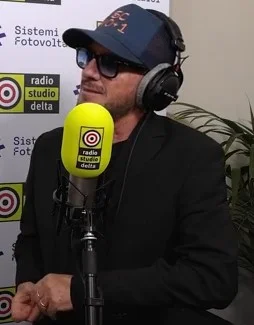
A shaved head, or a covered one, does not allow reading a hairline
The limitation here is more radical than what is usually encountered, and it is worth stating explicitly. In the recent photograph, the head is covered by a head covering: no observation about the hairline is possible, because the hairline is not in the frame. It is not a weak observation; it is an absent observation. Many pages built on the same material still choose to formulate a conclusion, and that conclusion cannot come from the image they claim to analyze.
The 2006 photograph poses a different but equally binding problem. On a very short shaved head, there is no hairline to evaluate: shaving is a stylistic choice that eliminates precisely the element one would want to measure. A shaved head can correspond to very thick hair as well as very thinning hair, and to the external eye the two situations appear identical. Added to this is the context: colored and raking stage lights, movement, sweat, and a low-angle shot significantly alter the way the scalp reflects light.
On this point, the NHS page on hair loss adds a decisive element precisely for shaved heads: scalp micropigmentation appears there as a separate entry from transplant and is described as a tattoo done to resemble short hair. On a shaved head, the photographic similarity between the two is maximal. Calling a “transplant” what one glimpses in a concert shot means choosing one explanation among several equivalent alternatives.
There remains the arithmetic limitation: two images separated by twenty years could in theory document a change, but only if both were readable. Here one is covered by a hat and the other shows a shave. The minimum condition for a comparison is not met, and simulating it would be improper.
The procedure described by the British health service
The general part of this page relies on the public documentation of the British National Health Service, which publishes a non-commercial page on the subject. There, a transplant is defined as the movement of hair to a thinning or bald area; the document specifies that it is not provided by the public service, being cosmetic surgery. It indicates it as suitable for permanent baldness, the kind that runs in families, and normally not suitable for other forms of hair loss, such as alopecia areata, which appears in patches.
The NHS describes two techniques. In follicular unit transplantation, or the strip method, a thin strip of skin with hair is removed from the back of the neck, then divided into grafts placed in small incisions; the donor area is sutured and leaves a scar that, it reads, should not be visible unless you wear your hair very short. In follicular unit extraction the back of the head is shaved and the units are removed individually. The operational differences between the harvesting and implantation methods are covered in the sheets on FUE transplant and DHI transplant.
How it is performed, what to expect afterwards and what risks the NHS indicates
According to the same sheet, the procedure is usually performed under local anesthesia with sedation, so the person is awake but should not feel pain; it typically takes a day, without the need to stay overnight, and on a large area it may require two or more sessions on different days.
Common consequences are indicated as a tight, sore and swollen scalp for a few days, temporary scabs in the transplanted area and a single scar or numerous very small scars. On the risk side, the document defines the procedure as generally safe, but notes a small risk of bleeding, infection or allergic reaction to the anesthetic, and a further small risk that the transplant may not take with hair loss, or that an obvious scar may form. Finally, it is noted that hair may continue to thin around the transplanted area, which is why the design should take this into account in advance.
None of this concerns a specific person: it is the general description that a national health service makes public.
The checks the NHS recommends before choosing
On choosing a facility, the sheet is very concrete. For those considering the procedure in England, it recommends checking that the hospital or clinic is registered with the Care Quality Commission, a requirement for all private cosmetic surgery facilities in the country. It notes that every doctor must be registered with the General Medical Council and hold a license to practice, and it indicates the British Association of Hair Restoration Surgery as a reference for verifying a surgeon's affiliation.
It then lists the questions to ask before deciding: qualifications and experience, number of similar procedures performed, how many involved complications, which technique would be recommended and why, what follow-up is planned in case of problems, and what patient satisfaction levels are. These are questions addressed to an identifiable professional, and that is the function of the sheets of our surgeons.
The document closes with a warning relevant to the research path that leads to this page: «Be careful when searching the internet for clinics that perform hair transplants. Some pay to advertise their services in search engine listings». The hair loss sheet also invites you to consult your doctor first to identify the cause of the loss, and only then a commercial facility.
Why a public figure's appearance does not anticipate your result
The NHS reminds that losing between 50 and 100 hairs a day is normal and often goes unnoticed, and that male and female pattern baldness is the permanent form, usually hereditary. As main treatments for male baldness, it cites finasteride and minoxidil, and states that no treatment is one hundred percent effective.
A practical consequence follows. The result depends on the individual pattern of loss, the density of the donor area and the design of the procedure: three elements that no photograph of another person can reveal. An individual assessment is the only tool that answers the personal question; general documentation serves to ask better questions, not to formulate a diagnosis.
Frequently asked questions
Has Raf had a hair transplant?
He has never publicly stated it and there is no verifiable source on the matter. The material in circulation comes from commercial pages, public comments and photo analysis videos.
What is seen in the photographs published here?
In the most recent one, the head is covered by a hat, so the hairline is not visible. In the one from 2006, the head is shaved very short, a condition that does not allow evaluating a hairline.
Why does a shaved head not allow conclusions?
Because shaving removes exactly the element one would want to observe, and because micropigmentation — which the NHS lists as a separate item from transplant — is described as a tattoo made to resemble short hair.
Are two photographs twenty years apart not enough?
No, because a comparison requires that both images be legible and taken under comparable conditions. Here one is covered by a head covering and the other shows a shave.
How do you get an answer about your own situation?
With an individual assessment. The outcome depends on the pattern of loss, the donor area and the design, and the NHS reminds that hair may continue to thin around the transplanted area.
Albania Hair Clinic has no professional relationship with Raf and makes no claims about his medical history. The general information is drawn from public NHS documentation and does not constitute personal medical advice.
Cover photo of Raf: Gianmaria™ — Wikimedia Commons, CC BY 2.0. Used under license; the photographer does not endorse this page and the image is not evidence of any procedure.
Photo in the article of Raf: Radio Studio Delta — Wikimedia Commons, CC BY 4.0. Used under license; the photographer does not endorse this page and the image is not evidence of any procedure.
Back to the index of famous people · What does a hair transplant involve

Reach Us Now
Speak with our expert DHI Hair Transplant specialist We're ready to answer your questions
:no_upscale()/media/ahc/images/2026/04/contact-doctors.webp)