:no_upscale()/media/ahc/images/2026/02/26f8b237813749afb443e051b9cbe47b.webp)
:no_upscale()/media/ahc/images/2026/08/francesco-totti-copertina-albania-hair-clinic.webp)
Totti and Hair Transplant: What Public Photos Show
Totti and Hair Transplant: What Public Photos Show
Francesco Totti has never spoken publicly about his hair, and this page does not fill that silence with speculation. The search that leads here is crowded with pages that reconstruct a complete clinical history, technique included, as if a document existed somewhere. It does not. Three things are kept separate here: the few observations that two licensed images actually allow, the limitations that make those observations fragile, and the documentation that a public health service makes available on the procedure in general.
Editorial note. Albania Hair Clinic has neither visited nor treated Francesco Totti and has no access to any medical records. Nothing on this page states or implies that Francesco Totti has undergone a hair transplant or any other treatment, at this clinic or elsewhere. The photographs shown here are licensed images that only identify the person: they are not before-and-after documentation, and the photographers do not endorse this page.
What Francesco Totti has said about his hair
As of the review date of this page, there is no record of any statement by the former Roma number ten about a hair treatment: no interview, no television appearance, no content published on his channels. Therefore, the only source that would be worth more than any other is missing, namely his own words. This page openly states this instead of filling that void with a reconstruction.
The material circulating online belongs to three genres, and none of the three is a source. The first is commercial: profiles by industry operators that describe a procedure in detail without ever indicating where they get the information. The second is conversational: fan discussions built on freeze-frames from matches. The third is the video format of photographic analysis, which starts from the same material and overlays a conclusion on it. The first genre has a direct economic interest in the answer it gives; the second and third rely on images that, for the reasons listed below, cannot bear that weight.
Only career data remain verifiable: according to Italian Wikipedia, Francesco Totti is a former Italian footballer born in 1976, a forward and midfielder, world champion with the national team in 2006 and European vice-champion in 2000. As for everything else, the correct answer is that it is not known.
The two licensed photographs on this page are almost thirty years apart
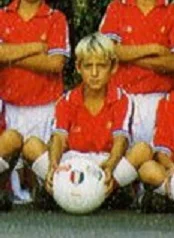
This is the most important point to clarify, and it goes in the opposite direction from what one might think. The cover image is dated by its author 12 August 2014 and shows him in profile, in training gear, on a grass pitch. The second image, below, belongs instead to the archive of the youth team Lodigiani: the image record on Wikimedia Commons places it in 1986, when the subject was a young boy.
Why two distant eras are not enough to build a comparison
Having images from different periods seems like the missing condition, but here the problem only shifts. Between the two photographs there are almost thirty years and, above all, the subject's entire adolescence. In popular literature on hair loss, a child's hairline and an adult's are not comparable quantities: the recession of the temples that accompanies the transition to adulthood is a common phenomenon and affects many men regardless of any treatment. Putting an image from childhood and one from adulthood in a row and presenting the difference as an outcome means passing off as proof a change that happens anyway.
Then there are the shooting conditions, and they are not a detail. The two images come from completely different media, optics, and lighting, decades apart: the color rendering, contrast, and definition of the hair edge change already for this reason. A long lens compresses planes and narrows the forehead, a short one widens it. The full light of a summer afternoon carves shadows that diffused light completely cancels. Sweat-soaked hair separates and reveals the scalp, while the same dry head appears fuller. A very short cut on the sides increases the contrast with the top and shifts the reading of the hairline with the same amount of hair.
An element that in practice confuses even more must be added. In the NHS page on hair loss, scalp micropigmentation, or permanent makeup, appears as a separate item from transplant and is described as a tattoo done to resemble short hair. In a photograph, the two outcomes can be almost indistinguishable. Choosing the word "transplant" in front of a freeze-frame means selecting one among several possible explanations, not recording a fact.
Photographic comparison only makes sense when images are taken under controlled and comparable conditions, with the same distance, the same light, and the same framing: this is why clinical documentation is carried out in a standardized way, as in the collection of before and after photos of our patients. None of these conditions apply to a photograph taken on the sidelines or during an awards ceremony.
What the British health service document actually contains
For the general part, this page refers to a source that sells nothing: the British National Health Service publishes an informative document about the procedure. It is worth reporting its content in blocks, because each block answers a different question from the one that brings users to a page like this.
What it is and who it is for. The transplant is defined as a procedure that moves hair to a thinning or bald area. The document clarifies two limitations at the outset: it is not covered by the public service, because it is classified as cosmetic surgery, and it is intended for permanent baldness, the kind that runs in families. It is indicated as normally not suitable for other forms of hair loss, for example, that which produces patches, alopecia areata.
The two ways of extracting hair. The text describes two and keeps them distinct:
- Follicular unit transplantation, the so-called strip method: a thin strip of skin with hair is removed from the back of the head, then divided into grafts that are placed in small incisions. The donor area is closed with stitches and a scar remains, which, the document specifies, should not be visible unless you wear your hair very short.
- Follicular unit extraction: the back of the head is shaved and the hairs are extracted one by one. This is the technique covered by the page on FUE hair transplant.
How the day goes. Local anesthesia with sedation, so the person is awake and no pain is expected; it usually takes a day, without an overnight stay; for large areas, the possibility of two or more sessions spread over different days.
Expected effects and risks, in the NHS list
The document separates what is expected from what can go wrong, and it is worth maintaining the same separation.
Among the common effects are a tight, sore, and swollen scalp for a few days, temporary scabs where the hair was transplanted, and a single scar or many tiny scars, depending on the extraction.
Among the risks, the procedure is generally considered safe, with the warning that there remains a small risk of bleeding, infection, or allergic reaction to the anesthetic, and a further small risk that the graft may not take, with hair loss, or that a highly visible scar may form. Added to this is the observation that will matter most over time: hair can continue to thin around the treated area, and the design of the procedure should be planned taking this possibility into account.
None of these elements describes a specific person. It is the general description that a national health service makes public.
The checks the document recommends doing beforehand
The same source devotes ample space to the method of choosing, and it is the part that promotional pages cite less willingly. For those considering the procedure in England, it indicates three checks:
- check with the Care Quality Commission that the hospital or clinic is registered, a requirement for all private cosmetic surgery facilities in the country;
- verify that the doctor is registered with the General Medical Council and holds a license to practice;
- consult the British Association of Hair Restoration Surgery to confirm the surgeon's affiliation.
This is followed by a list of questions to ask before deciding: what qualifications and experience the operator has, how many times they have performed this type of procedure, in how many cases complications arose, which technique they would suggest and why, what assistance is provided if something goes wrong, and what satisfaction results they can show. These are questions addressed to an identifiable person and not to a website: the pages of our surgeons exist to make this type of check possible.
The document closes the section with a warning that concerns exactly the path taken by those who arrive here: «Be careful when searching the internet for clinics that perform hair transplants. Some pay to advertise their services in search engine listings». In the hair loss page, a priority order is added: first your own doctor, to establish what is causing the hair loss, and only then a commercial operator.
Why the case of a public figure does not predict a personal result
Again, the NHS reminds us that losing between 50 and 100 hairs a day is normal and often goes unnoticed, and that male and female pattern baldness is the permanent form, usually hereditary. Among the main treatments for male pattern baldness, it lists finasteride and minoxidil, and states in writing that no treatment is one hundred percent effective.
The practical consequence concerns precisely those who seek an answer by observing someone else. The outcome depends on three individual variables — the pattern of hair loss, the density of the donor area, and the design of the procedure — and none of these can be read from a photograph of a different person. The useful comparison is not with a well-known figure, but with one's own situation, which requires a direct evaluation.
Frequently Asked Questions
Did Francesco Totti have a hair transplant?
There is no public statement from him on the matter, and no verifiable source attests to it. What circulates comes from commercial pages, fan discussions, and photographic analysis videos, never from the person in question.
Why doesn't this page publish a before-and-after comparison?
Because the two licensed images available are nearly thirty years apart, and in one, the subject is a young boy. The difference between a juvenile and an adult hairline manifests regardless and does not document any procedure.
Is a freeze-frame from a match enough to understand?
No. Sweat, stadium lighting, focal length, shooting angle, and cut length significantly alter the appearance of the hairline; moreover, micropigmentation can resemble short hair.
Why do other pages indicate a specific technique?
Because they do not cite a verifiable source. Information without an origin does not gain credibility simply by being repeated, and for this reason, it is not reported here.
What should one know for their own situation?
That the result depends on the individual pattern of hair loss, the donor area, and the design, and that the NHS notes the possibility that hair may continue to thin around the treated area. Only a direct evaluation provides an answer.
Albania Hair Clinic has no professional relationship with Francesco Totti and makes no claims about his medical history. The general information is drawn from public NHS documentation and does not constitute personal medical advice.
Cover photo of Francesco Totti: romazone — Wikimedia Commons, CC BY 2.0. Used under license; the photographer does not endorse this page, and the image is not proof of any procedure.
Photo in the article of Francesco Totti: Enzo Di Maio at Italian Wikipedia — Wikimedia Commons, public domain. The image is not proof of any procedure.
Back to the index of famous people · What a hair transplant involves

Reach Us Now
Speak with our expert DHI Hair Transplant specialist We're ready to answer your questions
:no_upscale()/media/ahc/images/2026/04/contact-doctors.webp)